
Expanding AI and HPC Access: How Cal Poly Pomona’s AI Sandbox Empowers Students
At Computing for Humanity, we believe that access to high-performance computing (HPC) and artificial intelligence (AI) resources should not be a barrier to innovation. When students and researchers have the tools they need, ideas can turn into real-world impact.
At California State Polytechnic University, Pomona, that vision is becoming reality through an AI Sandbox.
Supported by hardware contributions, including donations from Computing for Humanity, this initiative is helping democratize access to AI infrastructure, GPUs, and HPC systems.
Hands-On Learning with HPC and AI Infrastructure
From left to right, Kaitlin Yen, Bill Luong, Adam Webb, and Curtis Carpenter are unpacking the servers donated from Computing for Humanity and preparing to install them into the data center.
As a polytechnic university, Cal Poly Pomona emphasizes experiential learning—combining theory with real-world application.
According to Curtis Carpenter, Director of Advanced Computing at CalPoly:
“We create opportunities for students to gain hands-on experience with the same systems and technologies used in industry.”
This approach extends to student-led environments like the Student Data Center and now the AI Sandbox, where students work directly with enterprise-grade servers, GPUs, and AI tools.
What is the AI Sandbox? A Platform for Accessible AI Learning
An AI Sandbox is a hands-on learning environment that gives students, regardless of background, access to computing power, software, and data so they can experiment with AI, build models, and develop skills in a practical, low-risk setting.
Led by Bill Luong, System Administrator for Cal Poly Pomona's Security Operations Center, the project allows students to:
Install and manage compute hardware
Configure HPC systems and cloud environments
Run AI models and data science workflows using tools like JupyterHub
Gain practical experience in GPU computing and machine learning
“We wanted to create a space where any student—not just computer science majors—can experiment with AI,” Bill explains.
Bridging the Gap: Access to GPUs and AI Tools for Students
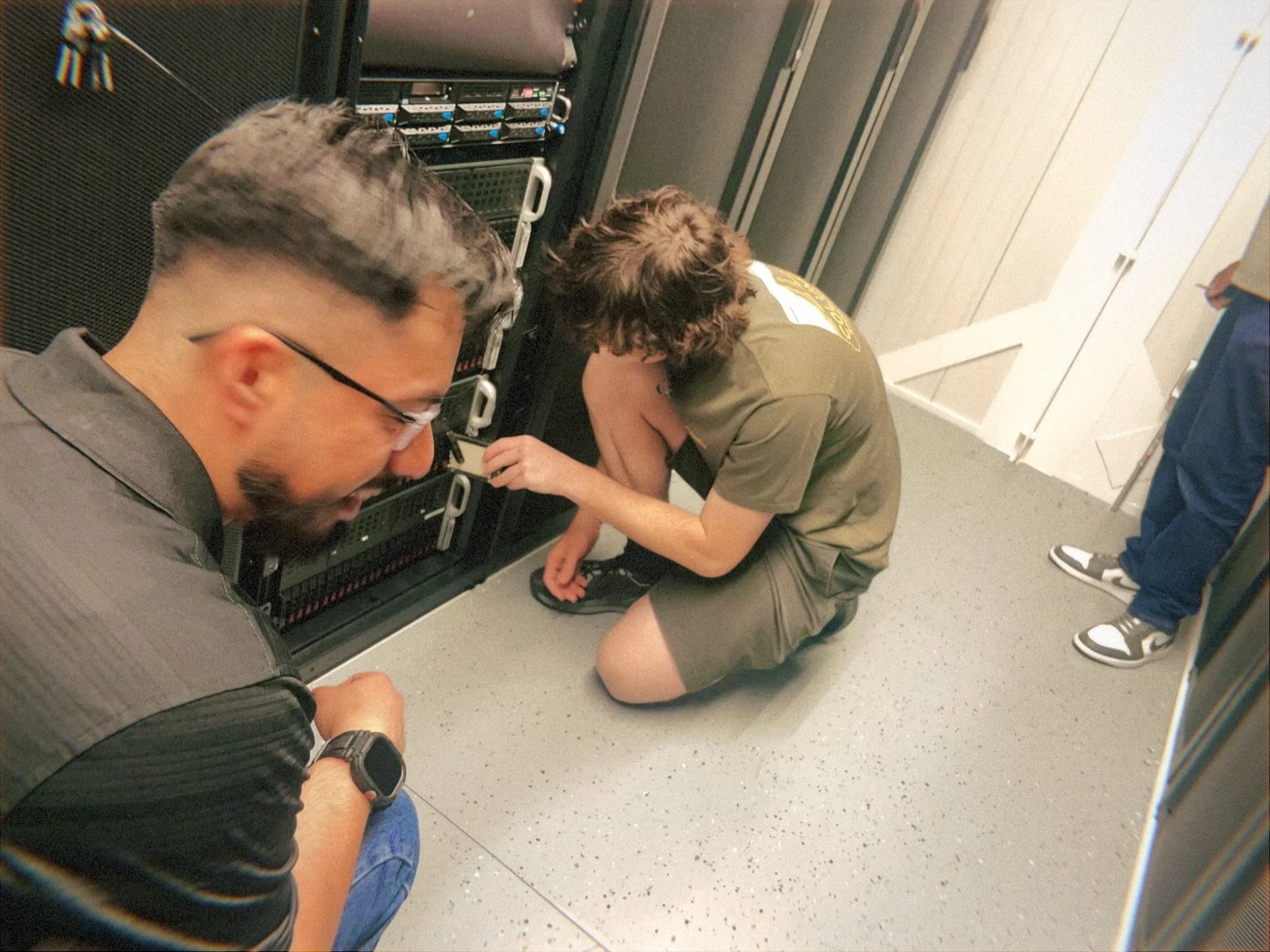
Adam Webb and Chris Serrano are installing new solid-state drives into the servers and verifying if the drives are properly installed.
A major barrier in AI education is limited access to GPUs and compute resources.
As Adam Webb, Director of Virtual Spaces, notes:
“Not every student can afford a machine with a GPU. This platform gives them access to tools they otherwise wouldn’t have.”
While cloud services exist, the AI Sandbox provides:
Local, reliable access to compute resources
A cost-effective alternative to commercial platforms
A learning-focused environment where students can experiment freely
This model aligns with global efforts to democratize AI and reduce barriers to entry in tech education.
Student-Led Innovation in HPC and AI
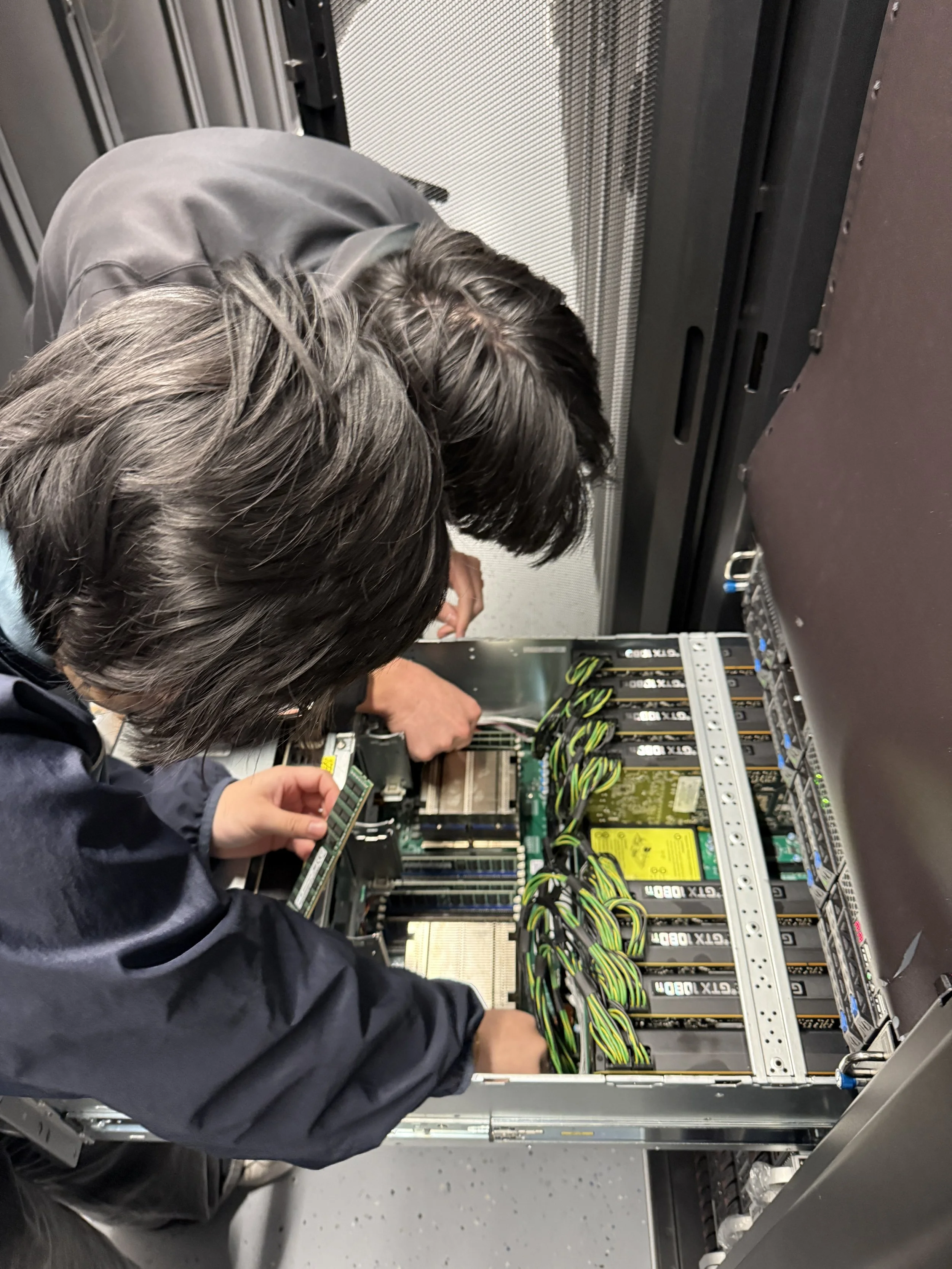
Kaitlin Yen and Bill Luong are installing additional RAM modules into the servers to increase the capacity of the environment.
One of the most unique aspects of this initiative is that it is built by students, for students.
Christopher J. Serrano, Artificial Intelligence (AI) and Geographic Information Systems (GIS) Support Student Worker, emphasizes the human impact:
“It’s about giving students the opportunity to explore and build with new technology.”
Meanwhile, Kaitlin Yen, Advanced Computing Department Student Assistant, highlights the collaborative nature of the project:
Partnerships with data science and AI student groups
Real-world projects using external datasets
Cross-disciplinary collaboration across campus
This creates an ecosystem where AI, data science, and domain expertise intersect.
HPC and AI Beyond Computer Science: Interdisciplinary Impact
The AI Sandbox is intentionally designed to support students from all disciplines, not just technical fields.
Applications may include:
Humanities students exploring data storytelling and digital research
Environmental projects using local and scientific datasets
Business and social science applications of AI-driven insights
As Curtis Carpenter explains:
“There are applications for this technology across every major.”
This approach reflects a growing trend in interdisciplinary AI and HPC adoption.
Why Democratizing Compute Matters for Innovation
The AI Sandbox demonstrates a powerful model for expanding access to technology:
Repurposed hardware → accessible HPC infrastructure
Accessible infrastructure → broader participation in AI
Broader participation → stronger innovation ecosystems
At Computing for Humanity, this is central to our mission: ensuring that no researcher or student is left behind due to lack of compute resources.
The Future of AI Education and Accessible HPC
As demand for AI skills grows, access to training environments, GPUs, and compute platforms will be critical.
Initiatives like the AI Sandbox:
Prepare students for careers in AI, data science, and HPC
Reduce inequality in access to technology
Enable innovation from diverse and underrepresented communities
As Christopher J. Serrano reflected:
“Having access to this kind of environment early on can change everything.”
This reflection is supported by Alex Hardwood, Associate Vice President of Advanced Computing and Chief Technology Officer, “The goal of this project is to replicate our success with our student run data center and student run security operation center, to provide students with hands-on practical experience of creating an AI environment from scoping the equipment, identifying the necessary hardware and peripherals, installing the operating systems, the security measures, networking, to the AI stack including design and implementation to operations. Giving our students these opportunities help prepares them for their future real-world experiences and careers.”
Get Involved: Support Access to HPC and AI
The success of the AI Sandbox highlights the importance of partnerships and hardware donations.
If your organization has servers or GPUs to donate, or if you’re interested in supporting equitable access to AI and HPC, we invite you to connect with us.
Together, we can build a future where innovation is not limited by access to technology.
No human should wait for compute.