
Dr. Hamzeh Khazaei: Why Canada's AI Future Depends on Accessible Research Computing
Dr. Hamzeh Khazaei on cloud computing, AI infrastructure, and why equitable access to computing resources will shape the next generation of scientific discovery.
The first thing Dr. Hamzeh Khazaei wanted to share during our visit to the Performant and Available Computing Systems (PACS) Laboratory at York University wasn't a GPU cluster or a cloud platform—it was his students. As we walked through the lab, he introduced each member of his research group with genuine pride, describing their projects and explaining how he mentors them according to their individual strengths, interests, and career aspirations. Before we discussed artificial intelligence, cloud computing, or the future of research computing in Canada, one message was already clear: groundbreaking research begins by empowering people.
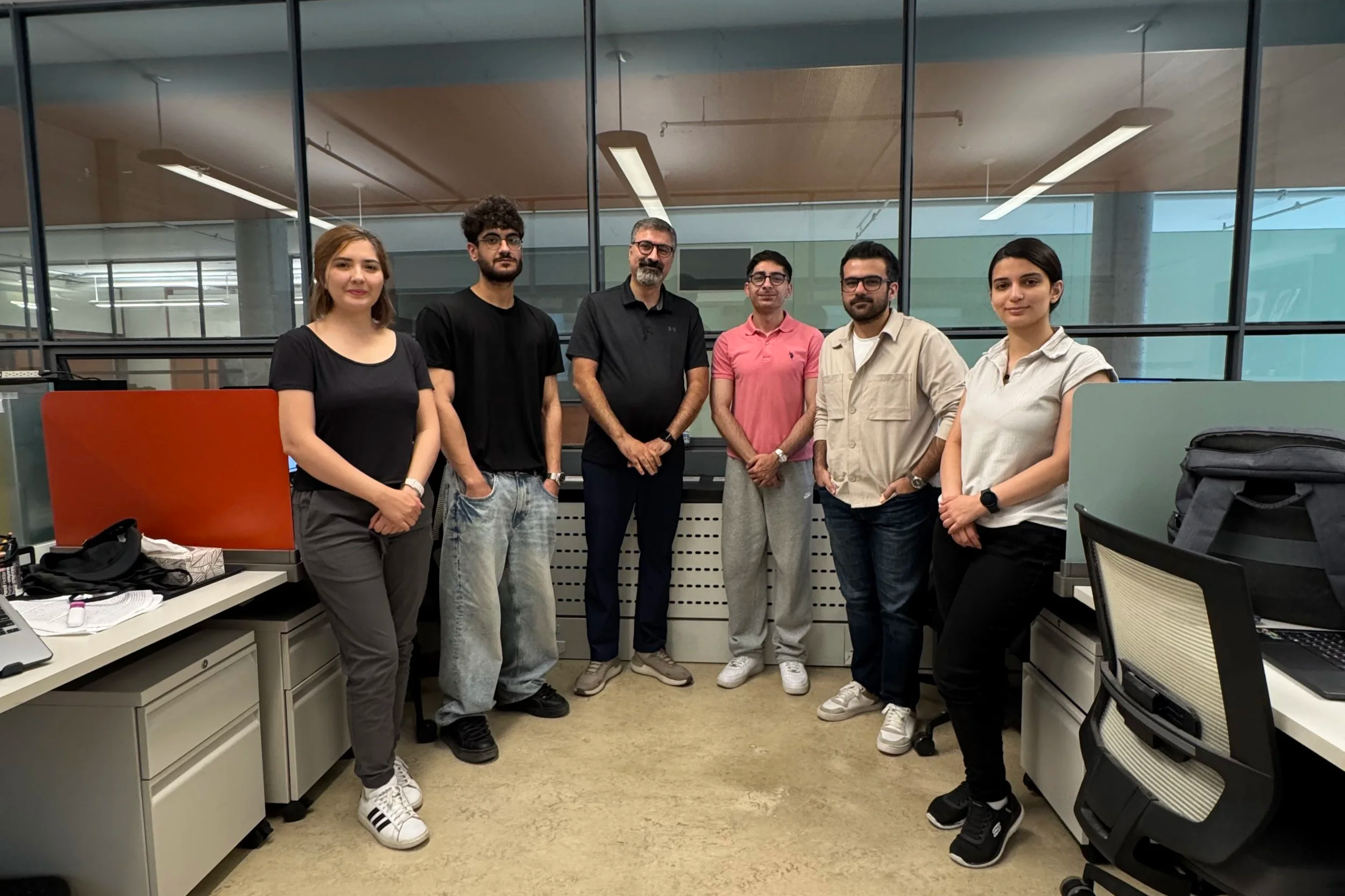
From left to right, Hanieh Kashfi, Alireza Abedini, Hamzeh Khazaei, Arian Boukani, Alireza Pourali, Niki Mahmoudi, members of the PACS Lab
That conviction is also why his work resonates so strongly with the mission of Computing for Humanity: no human advancement should wait in line for computing time. For Dr. Khazaei, empowering people and expanding access to computing are the same project seen from two sides.
As Associate Professor at York University and Director of the PACS Laboratory, Dr. Khazaei has spent his career at the intersection of cloud computing, distributed systems, edge computing, and artificial intelligence—fields that now sit at the foundation of the entire digital research ecosystem.
At the PACS Lab, this vision translates into a concrete research agenda: improving computing systems to better serve machine learning workloads. Modern ML places unique demands on infrastructure—training requires massive, sustained computation across expensive accelerators, while inference must deliver predictions quickly, reliably, and at reasonable cost as demand fluctuates. Dr. Khazaei's team studies how cloud and distributed systems can be designed, managed, and optimized to meet both challenges, improving the performance, scalability, and cost-efficiency of ML training and inference pipelines. The goal is to ensure that the systems underneath AI keep pace with the models running on top of them—so that computational resources, wherever they come from, deliver the greatest possible value to the researchers who depend on them.
"Cloud computing is no longer optional," he explains. "It has become the infrastructure that enables modern research."
Researchers across disciplines—from healthcare and biomedical sciences to engineering, environmental science, and artificial intelligence—are generating unprecedented volumes of data. Machine learning models have grown dramatically in size and complexity, requiring computational resources that many laboratories could scarcely imagine a decade ago. Yet while scientific ambition continues to accelerate, access to computing infrastructure has not kept pace. The Government of Canada itself has acknowledged this gap, describing the country's sovereign compute capacity as "nascent" and committing $2 billion to a Sovereign AI Compute Strategy to expand it.
Research Is No Longer Limited by Ideas
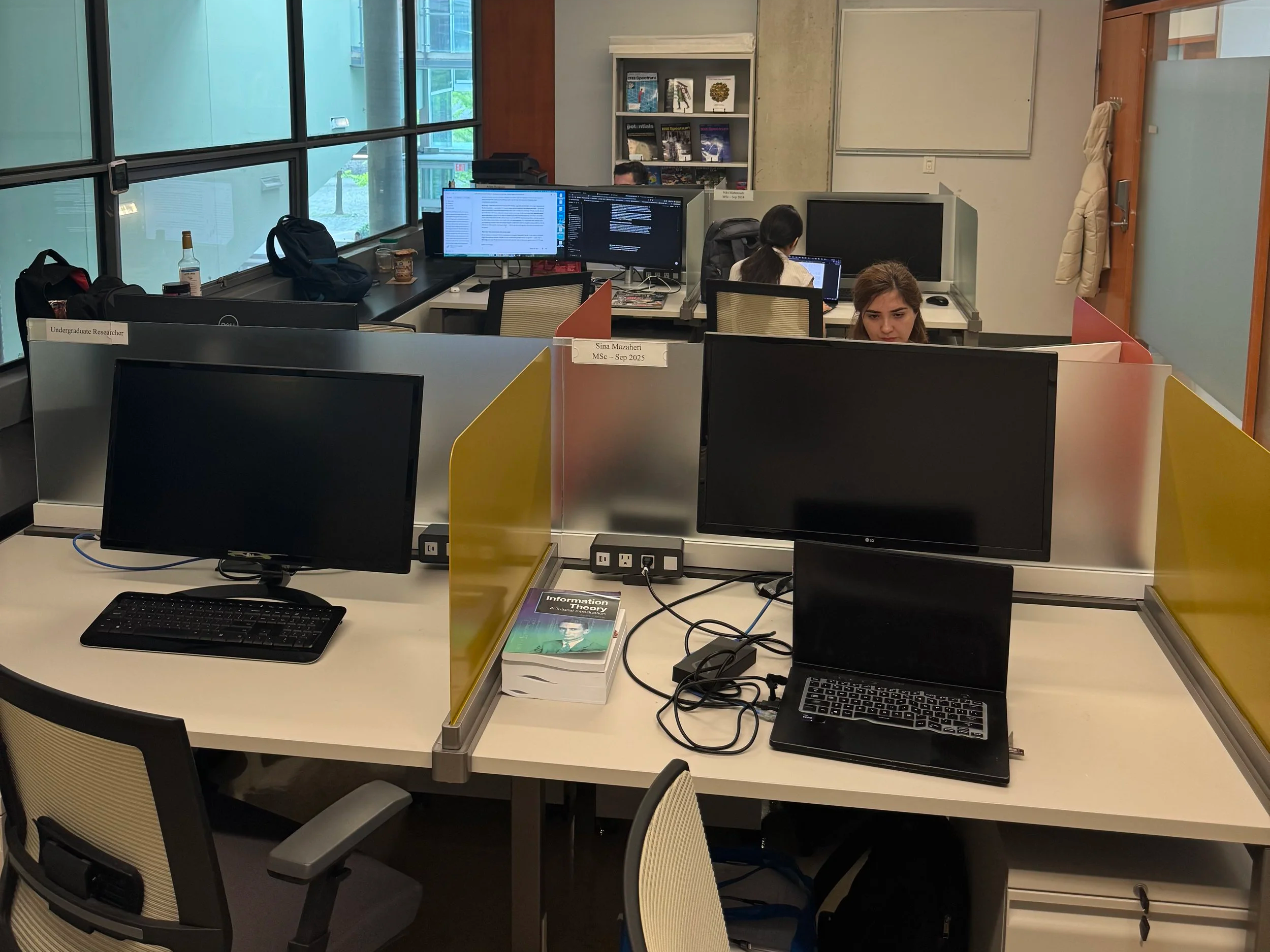
At PACS Lab, researchers from BSc students to postdoctoral fellows collaborate to advance efficient, reliable computing systems through cloud, AI, and distributed systems research
Dr. Khazaei believes one of the greatest misconceptions about artificial intelligence is that the biggest challenge lies in developing better algorithms.
"In many cases," he suggests, "researchers already know what they want to investigate." The real challenge is having the computational capacity to test those ideas. Modern AI research is inherently iterative: researchers train models, evaluate results, adjust parameters, and repeat the process dozens—sometimes hundreds—of times before reaching meaningful conclusions. Every iteration consumes computing resources.
This is precisely the bottleneck Computing for Humanity was founded to remove. When compute is too expensive, too difficult to access, or simply unavailable, promising research stalls—not for lack of ideas, but for lack of infrastructure.
"The cloud gives researchers flexibility," Dr. Khazaei explains. Rather than investing heavily in hardware that may become outdated within a few years, cloud platforms allow research teams to scale computing resources according to the changing needs of individual projects. That matters because universities and research institutes must balance finite budgets with rapidly expanding computational demands: purchasing new GPU clusters every few years is simply not financially realistic for many organizations, particularly smaller institutions and nonprofit research groups. And while commercial cloud services offer virtually unlimited scalability, the cost of sustained GPU use quickly becomes prohibitive for academic research groups.
The consequence is sobering: access to computing infrastructure is beginning to influence not only how research is conducted, but which research questions can realistically be pursued—and by whom.
The Infrastructure Behind Artificial Intelligence
Public conversations about AI often focus on large language models, robotics, or breakthrough applications in medicine. Far less attention is given to the infrastructure that makes those advances possible: thousands of hours of computation, vast storage systems, high-speed networking, and carefully configured software environments.
"People often see the results," Dr. Khazaei says, "but they don't always see the infrastructure that made those results possible."
This growing dependence on computational infrastructure is reshaping the priorities of Canadian research computing providers. While Canada's national research computing ecosystem continues to play a vital role, the rapid expansion of AI has increased demand for complementary models that offer researchers greater flexibility, persistent computing environments, and more immediate access to specialized hardware.
Dr. Khazaei sees this not as competition between providers, but as an opportunity to strengthen Canada's overall research ecosystem through complementary approaches. Different projects have different computational needs: some require national supercomputers; others benefit from persistent virtual environments where software, data, and experiments remain available over long periods. Increasingly, researchers need both.
Preparing Researchers for an AI-Driven World
Perhaps nowhere is this transformation more visible than in the classroom.
As Director of the PACS Laboratory, Dr. Khazaei works closely with graduate students preparing for careers in academia and industry. He believes universities can no longer rely solely on traditional lectures and small classroom assignments to prepare students for modern AI careers.
"We are really past that time that you can lecture people and they do very tiny student-size projects and then go out and find a job," he says. "At least in our area, that's pretty much impossible these days. You need to get the taste of industry-scale computing even at university." If students cannot experiment on realistic resources, he explains, "they are not going to have an upper hand in the job market."
That philosophy shapes how he mentors students. Rather than teaching cloud computing as a purely theoretical subject, he emphasizes practical experience with the same technologies students will encounter after graduation. And as AI-assisted coding tools automate routine programming tasks, he believes future professionals will need expertise that extends well beyond writing software—into distributed systems, cloud architecture, infrastructure optimization, and AI deployment.
An important thread of the PACS Lab's research reflects the same concern for people that Computing for Humanity places at the centre of its mission: advanced systems are only valuable if individuals can actually access and use them. Many researchers, students, and learners still struggle to integrate AI tools into their work. Dr. Khazaei calls this the "infrastructure tax"—the technical burden created when users lack the expertise required to set up computational environments, manage complex systems, or share resources effectively. One of the lab's active research directions is reducing these barriers and improving AI literacy among scientists, students, and communities—making AI genuinely accessible to everyone, not just those with specialized systems expertise.
A Shared Vision: Computing Without Waiting in Line
These evolving needs are prompting new models for research computing in Canada—and this is where nonprofit initiatives can make a meaningful contribution.
Computing for Humanity developed myresearchcloud.ca to complement Canada's research computing ecosystem by providing researchers, educators, students, and nonprofit organizations with free and affordable research computing through a shared, Canadian-hosted cloud platform. Rather than replacing national infrastructure or commercial cloud providers, it fills the gap Dr. Khazaei describes: researchers can launch virtual machines within minutes and maintain persistent environments where applications, datasets, notebooks, and configurations remain available throughout the lifecycle of a project.
For educators, these persistent environments allow entire classes to work with the same software configurations—reducing the very "infrastructure tax" Dr. Khazaei studies, and letting students focus on experimentation rather than system administration. For researchers, they improve reproducibility, a cornerstone of rigorous science. And through free entry-level access and free GPU compute for research, the platform reaches exactly the groups Dr. Khazaei worries are being left behind: smaller research groups, nonprofit organizations, students, and early-career investigators.
For Dr. Khazaei, expanding access to computing infrastructure is ultimately about expanding opportunity. When researchers and students spend less time worrying about hardware availability and more time exploring ideas, innovation accelerates.
The stakes for Canada are real. The country pioneered the world's first national AI strategy and remains home to world-class AI researchers and internationally recognized institutes such as Amii, Mila, and the Vector Institute. But maintaining that leadership is not guaranteed: it will require continued investment in computing capacity and talent—not only for established laboratories, but for the students, early-career researchers, and smaller institutions who represent the next generation of Canadian discovery. Expanding access to research computing is therefore more than a question of convenience. It is an investment in Canada's long-term capacity for innovation.
Sustainability Can Drive Scientific Discovery
Dr. Khazaei also sees an opportunity that extends beyond performance: sustainability.
Modern data centres require substantial investments in hardware, electricity, cooling, and maintenance. At the same time, organizations routinely retire servers that still possess years of useful computational life. This is one of the ideas that makes Computing for Humanity's approach particularly compelling to him: instead of allowing enterprise servers to become electronic waste, donated infrastructure is refurbished and integrated into Canada's nonprofit research cloud—creating additional computing capacity for researchers while reducing unnecessary hardware disposal.
It is a virtuous cycle in which environmental sustainability and scientific progress reinforce one another. As Dr. Khazaei notes, enabling underutilized hardware to continue serving researchers is simply a smarter use of existing resources.
The Future Depends on Access
As Dr. Khazaei's experience demonstrates, cloud computing has evolved from a technical convenience into a fundamental pillar of modern research. The challenge now is ensuring that this infrastructure becomes more accessible, more sustainable, and more collaborative.
That is the future Computing for Humanity is working to build—one where donated infrastructure, nonprofit innovation, and shared cloud resources work alongside universities and national computing providers so that, in Canada, no promising idea has to wait in line for computing time.