A great idea shouldn't have to wait for a bigger computer. Across Canada, students and researchers are ready to explore artificial intelligence, climate science, biology and more, but many don't have the computing power to try.
Since 2015, Computing for Humanity has worked to change that. We have delivered more than 990 million CPU core hours and 13.6 million GPU hours, backed by more than 24,500 volunteer hours and partnerships with 32 universities and research centres (as of Q3 2026). Today, through myresearchcloud.ca, our nonprofit research cloud, we are focused on students, educators and underserved researchers.
You can help them through six programs. Each has its own purpose, and you choose the one that matters most to you.
The need is real
We receive about 7 to 10 requests every week for free research computing. Around 60% come from undergraduate students, 20% from graduate students and 10% from professional and independent researchers.
Today we support approximately 70 to 100 free computing allocations a year. Our goal is to expand our infrastructure to support 400 additional students and researchers every year. Th1at takes servers, electricity, hosting, maintenance and the technical specialists who keep everything running, and donations help pay for it.
Six programs, six ways to help
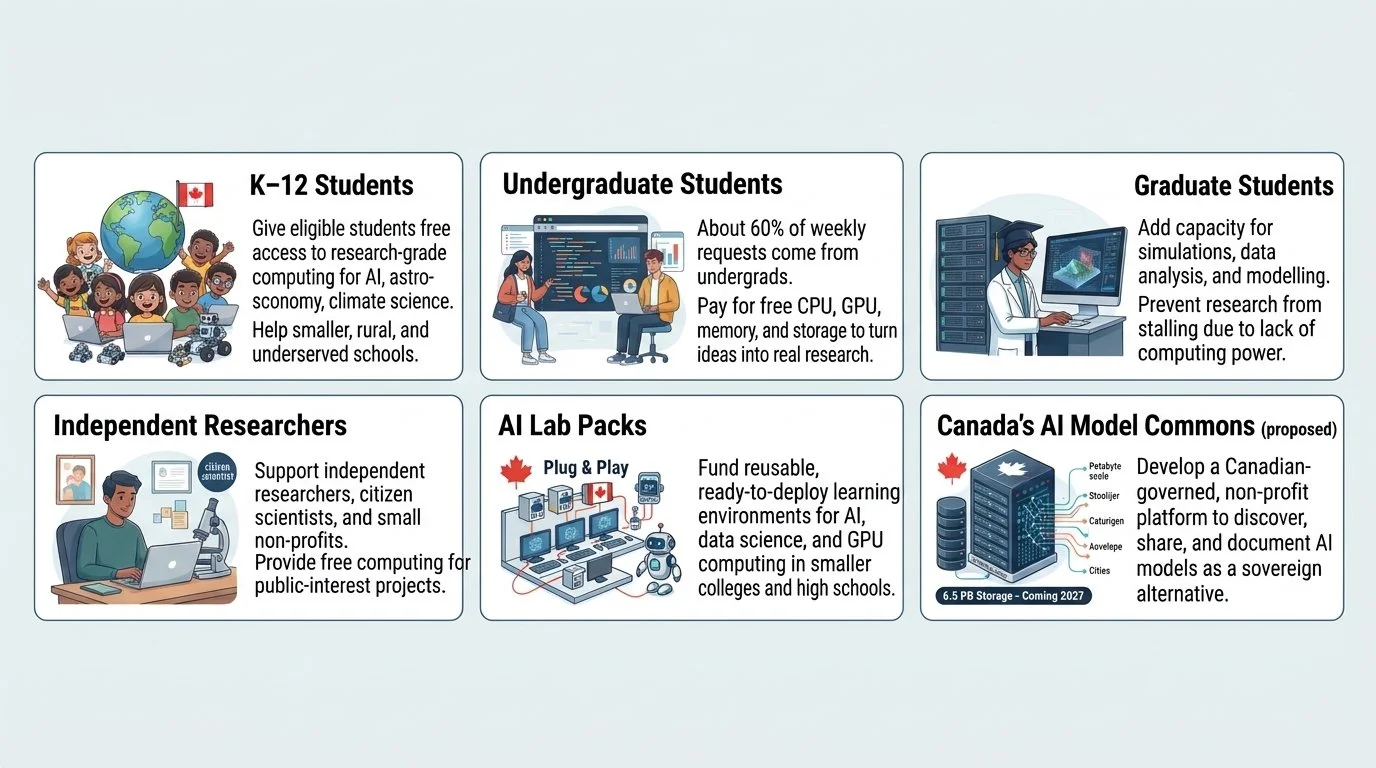
1.K–12 Students
Many schools lack the specialized computers, technical staff and budget for advanced projects. Your gift gives eligible students free access to research-grade computing to explore AI, astronomy, climate science and biology, including students at smaller, rural and underserved schools. In Florida, two donated servers gave a high school Science Olympiad team university-grade computing.
2. Undergraduate Students
About 60% of our weekly requests come from undergraduates, yet traditional programs often favour graduate students and funded groups. Your gift pays for free CPU, GPU, memory and storage, plus technical help, so a student's idea can become real research now. At Cal Poly Pomona, four donated servers let students and faculty build an AI environment from the ground up.
3.Graduate Students
Research shouldn't stall because a student runs out of computing power. Even at major universities, allocation limits and competing demand can leave good projects short. Your gift adds capacity for simulations, data analysis, machine learning and modelling, with help setting it all up.
4.Independent Researchers
You shouldn't need a major university behind you to contribute to science. Independent researchers, citizen scientists and small nonprofits often can't afford commercial cloud prices. Your gift provides free computing for eligible non-commercial, public-interest projects.
5.AI Lab Packs
Students learn AI by doing, but many smaller colleges, trade schools and high schools can't afford GPU servers or specialized lab staff. Lab Packs are reusable, ready-to-deploy learning environments for hands-on AI, data science and GPU computing. Your gift funds building them, including software, exercises, testing and instructor resources. It does not pay individual students' access or tuition.
6.Canada's AI Model Commons
We are developing the concept for a Canadian-governed, nonprofit platform where researchers can discover, share and document AI models, as an alternative to relying only on large foreign commercial platforms. We are preparing to deploy about 6.5 petabytes of shared storage, with deployment planned to begin in 2027. Your gift helps develop the model registry, security and governance tools.
How to give
You can give on CanadaHelps, or through your employer's giving platform on Benevity. On either one, choose the fund that matches the program you want to support: K–12 Students, Undergraduate Students, Graduate Students, Independent Researchers, AI Lab Packs or AI Model Commons.
Monthly gifts help us plan for the ongoing cost of running the cloud. Suggested monthly amounts are C$25, C$50, C$100 and C$250, and other amounts are welcome. Gifts support a shared pool of computing resources for each program.
We still support World Community Grid and Rosetta@home
Since 2015, our infrastructure has also powered global science projects such as World Community Grid and Rosetta@home, which helped shape who we are today. We remain committed to supporting them. Our current fundraising focus is the six programs above.
Help the next discovery happen
Choose the program that speaks to you, and give once or monthly on our Support Research page.
Allocations are subject to eligibility, availability and acceptable-use requirements. Applications involving minors require parent, guardian or educator involvement. Lab Pack donations fund development, not individual student access or tuition. Model Commons is a proposed initiative; features and availability will evolve.